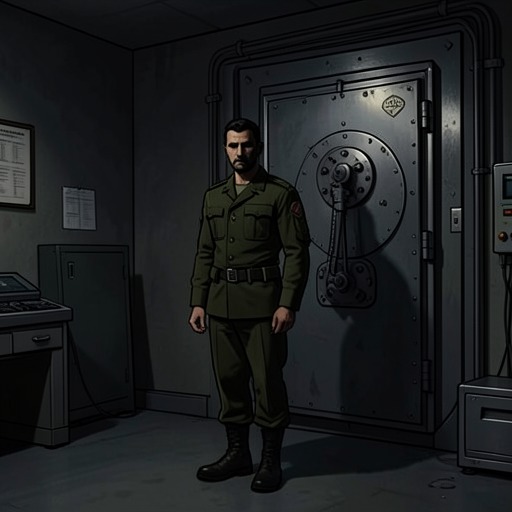
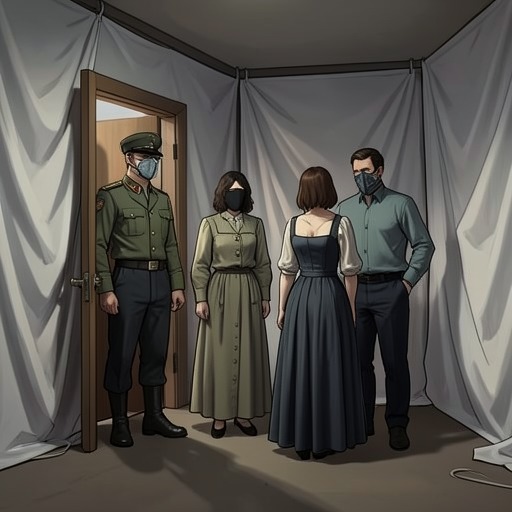
Michael Downey attacks the Farm and takes Dinah
Down Cemetery RoadMichael Downey attacks the Farm and takes Dinah is known not through a narrated account of the assault itself, but through the scene Zoë and Sarah encounter afterward. Their search across the island leads from a body outside a farmhouse to more victims within it; Sarah recognizes the devastation as the work of the man she had trusted and understands that Dinah has been taken. The event turns a rescue into a confrontation with the apparent cost of Michael’s intervention, while leaving the precise sequence and full extent of the violence uncertain.
Causes and Background
Zoë and Sarah are searching for Dinah on the island when they come upon the farmhouse. The account does not show Michael’s approach, explain how he entered, or describe a fight. Instead, its evidence comes from what remains: people shot, a wounded woman, and Sarah’s later inference that Michael arrived during the night or early morning and left with Dinah. The attack is therefore reconstructed from the survivors’ discoveries rather than directly witnessed.
Sarah’s identification of Michael is personal as well as circumstantial. She has to place the destruction before her beside the man she thought she knew, and beside the fact that she had shared a bed with him. Her response is not simple disbelief: she considers whether knowing his capacity for violence would have changed her willingness to accept his help. The event’s background thus includes the collapse of her prior understanding of him, even as the evidence does not establish exactly what he did to each person at the Farm.
The Farm’s Aftermath
The first body lies face-up only yards from what appears to be an old stone farmhouse built into a dip in the rock. The dead man had been holding an apple. Zoë judges that his death was violent, but does not turn him over to confirm the circumstances. Sarah calls attention to another body, though Zoë realizes she means the one already before them. The exchange registers the shock of the discovery: Sarah seems disconnected, while Zoë focuses on keeping her moving and offers the small silver gun she has brought along.
Inside, Zoë finds another dead man in the kitchen, beside an oven and a sink still piled with dirty dishes. A deep, dark stain across the blue cotton of his shirt indicates that he has been shot. Zoë’s thoughts remain practical even as shock and fear begin to paralyze her: the man is dead, but neither she nor Sarah has been shot. The ordinary kitchen fittings and unwashed dishes make the violence feel less like a distant report than an interruption of domestic life. A deeper buzzing sound follows Sarah’s caught breath and then fades, but the scene does not identify its source.
A noise from behind a closed door draws Zoë down a corridor lined with heavy wooden doors. When the nearest door swings open and stops against something soft, she first thinks she has found another body, perhaps a child’s. A movement to her left changes that expectation: a woman is alive, curled against the wall, frightened and visibly hurt. Zoë sees that the woman’s folded hands are bleeding and believes she has been shot. Sarah warns Zoë to be careful, then asks to see the woman. The discovery shifts the scene from counting the dead to confronting the immediate, unresolved question of how to help someone who may be dying.
Dinah’s Removal and the Teddy Bear
The Farm’s scattered signs of violence acquire a more definite meaning when Sarah understands that Dinah is gone. Zoë had already associated the first body with Michael’s presence; Sarah’s later reconstruction is more conclusive. She believes he came in the night or early morning, left the mayhem behind, and took Dinah. The narrative offers this as Sarah’s understanding of the aftermath, not as a witnessed account that establishes the exact circumstances of the removal.
A large blue teddy bear lies by a doorway, having obstructed it. Zoë notices what blocked the door before she goes outside, and Sarah later sees the bear and concludes that it too has been shot. Its presence makes the violence legible through an object associated with a child, without explaining who shot it or when. Sarah retrieves it and returns to the wounded woman, who is still breathing. The bear cannot repair what has happened or tell Sarah where Dinah has gone; carrying it back is the limited act of care available to her in the ruined house.
Consequences and Significance
For Sarah, the apparent rescue of Dinah does not cancel the massacre left behind. She recoils from the possibility that Michael is a war criminal and tries to reconcile that judgment with the man who once saved her life. Her thoughts reach back to Maddy Singleton, whose marriage to Michael’s fellow soldier Thomas Singleton complicated any hope Michael might have had. Sarah knows only dimly the bond between the two men, but understands that it was sealed in blood and not easily broken. These reflections do not explain the attack’s tactical purpose; they show how its aftermath forces Sarah to reconsider Michael’s history and loyalties.
The event’s decisive change is consequently double. Dinah has been removed from the Farm, and the evidence suggests that Michael is responsible for a large-scale outbreak of violence; at the same time, one wounded woman remains alive, making the consequences immediate rather than wholly past. Zoë’s response moves from armed caution to approaching the injured woman with her gun put away. Sarah’s moves from recognizing the missing child to carrying the teddy bear back to the survivor. The scene leaves the attack’s details unresolved, but makes its human cost impossible for either woman to treat as incidental.